

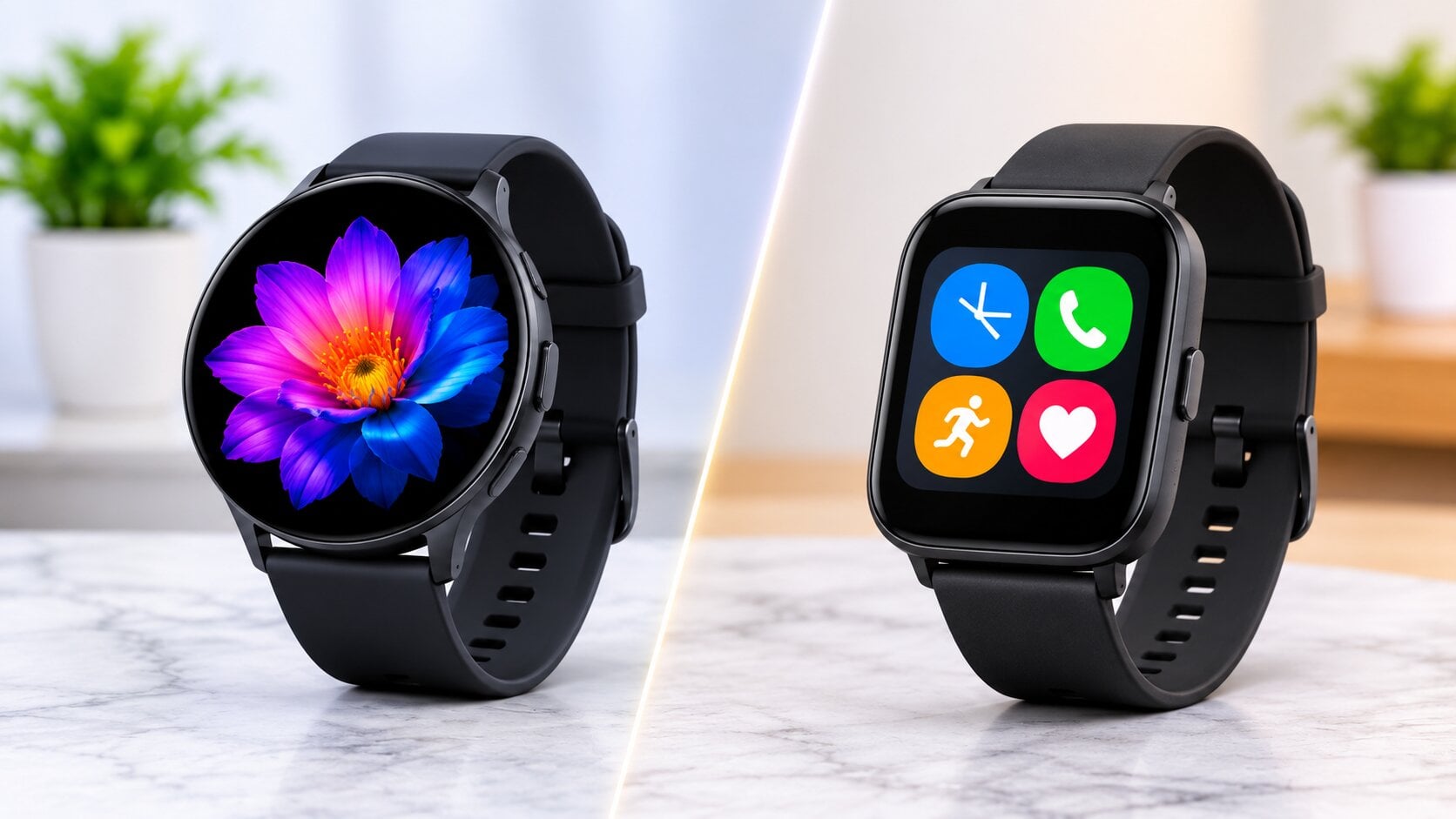
Two budget smartwatches sit side by side on our counter. Same strap, same features list, almost the same size. One has an AMOLED screen and the other a basic colour display, and customers ask us the same question every week: is the difference worth paying for? The screen is the part of a smartwatch you look at a hundred times a day, so it shapes how the whole watch feels. It decides whether you can read a message in the afternoon sun, how long the battery lasts, and how premium the watch looks on your wrist. This guide breaks down both display types in plain terms, so you can browse our smartwatches collection knowing exactly what you are paying for. Start with how you will use the watch.
Pick AMOLED if you want sharp colours, deep blacks, an always-on display, and better sunlight visibility. Pick a basic colour display (TFT or IPS LCD) if you want the lowest cost and mostly check the time, steps, and notifications.
What Is the Difference Between AMOLED and a Basic Colour Display?
An AMOLED screen has no backlight. Every pixel produces its own light and switches off completely when it shows black. That gives true blacks, strong contrast and colours that look rich even on a small screen.
A basic colour display, usually labelled TFT or IPS LCD, works differently. A backlight sits behind the whole panel and stays on whenever the screen is awake. Black areas are really dark grey because light still leaks through. Colours look flatter, and viewing angles on cheaper TFT panels can wash out when you tilt your wrist.
Neither technology is broken. They simply suit different buyers and different budgets.
How Each Screen Performs in Daily Life
Readability Outdoors
Anyone who has stood at a Karachi or Lahore bus stop in June knows the problem. Bright sunlight washes out a weak screen until you have to cup your hand over it. AMOLED panels on budget watches usually reach higher peak brightness and, thanks to their contrast, white text on a black face stays readable. Basic LCD screens can work outdoors too, but lower brightness and grey blacks make them harder to read at midday. If you walk, ride a bike or work outside, this point alone can decide it.
Battery Life
This is where things get interesting. Because AMOLED pixels switch off for black, a dark watch face uses very little power. That is why many AMOLED watches offer an always-on display, which keeps the time visible without raising your wrist. The catch: leave always-on display running all day and battery life can drop sharply. With it turned off, an AMOLED watch often matches or beats an LCD model.
A basic display lights the whole backlight regardless of what is on screen, so a bright face and a dark face cost roughly the same power. Some budget LCD watches compensate with bigger batteries, so always compare the rated battery life on the product page rather than assuming one screen type wins.
Looks and Feel
AMOLED watch faces simply look more expensive. Photos, maps and colourful widgets pop, and black backgrounds blend into the bezel so the screen appears larger. On a basic display, the bezel edge is easier to spot and colours look closer to a calculator than a phone. If the watch will be on your wrist at the office or at a dawat, many buyers find the AMOLED upgrade worth it for looks alone.
Durability and Long-Term Use
AMOLED panels can show slight burn-in if the same bright elements stay on screen for months, which is mainly a concern with always-on display. Rotating watch faces avoid it. LCD screens don’t burn in, but cheaper TFT panels can develop uneven backlight over time. In practice, the glass and build quality matter more than the panel type for scratches and cracks.
AMOLED vs Basic Display at a Glance
- Contrast: AMOLED gives true blacks; basic displays show greyish blacks.
- Sunlight: AMOLED is usually easier to read outdoors.
- Always-on display: common on AMOLED, rare and power-hungry on LCD.
- Battery: depends on settings and battery size, not screen type alone.
- Cost: basic colour displays keep the price lowest.
Who Should Choose Which Screen?
A basic colour display makes sense for first-time smartwatch users, students, older parents who want a simple step counter, or anyone buying a backup watch for the gym. If you mostly check the time, steps, and incoming call alerts, you won’t miss the extra contrast.
AMOLED is the better buy if you read messages on your wrist, use Bluetooth calling often, spend time outdoors, or want a watch that looks closer to a premium brand. Brands like Zero have pushed AMOLED panels into far more affordable models, and you can compare them in our Zero smartwatches range.
How to Spot a Fake AMOLED Claim
Online listings in Pakistan sometimes call any colourful screen “AMOLED.” Here is a simple test we use at the store. In a dark room, set a fully black watch face and turn the brightness up. A real AMOLED screen stays completely black, with no glow around the edges. A TFT or IPS LCD screen will show a faint grey glow across the panel because the backlight is still on. Also check the spec sheet for a named panel type and resolution. Vague wording like “HD colour screen” usually means LCD.
What to Check Besides the Screen
The display is only part of the decision. Check that the watch app works with your phone, whether Bluetooth calling has a usable speaker and mic, how the watch charges and whether the strap uses a standard size you can replace. Water resistance matters too if you wear it for wudu or workouts. A great screen on a watch with an unreliable app will still frustrate you.
Key Takeaways
AMOLED wins on contrast, sunlight readability, looks and always-on display. A basic colour display wins on cost and suits simple, everyday tracking. Battery life depends more on your settings and battery size than the panel itself. Test any AMOLED claim with a black screen in a dark room before trusting the label.
Ready to compare? Explore our full range of budget smartwatches in Pakistan with cash on delivery, or message our team on WhatsApp and we will help you choose the right screen for your routine.
Frequently Asked Questions
Is AMOLED better than TFT on a smartwatch?
For most people, yes. AMOLED offers deeper blacks, richer colours and better sunlight visibility. TFT costs less and handles basic tracking well.
Does an AMOLED smartwatch drain the battery faster?
Not by default. Dark watch faces save power on AMOLED. Battery drops mainly when the always-on display stays enabled all day.
Can a budget smartwatch have an AMOLED display?
Yes. Many affordable watches now use AMOLED panels. Check the spec sheet for the panel type and resolution before buying.
How can I tell if my smartwatch screen is really AMOLED?
Show a black watch face in a dark room. AMOLED stays fully black, while an LCD screen shows a faint grey glow.
Which smartwatch display is easier to read outdoors?
AMOLED is usually easier to read in bright sunlight because of its higher contrast and stronger peak brightness on most budget models.