

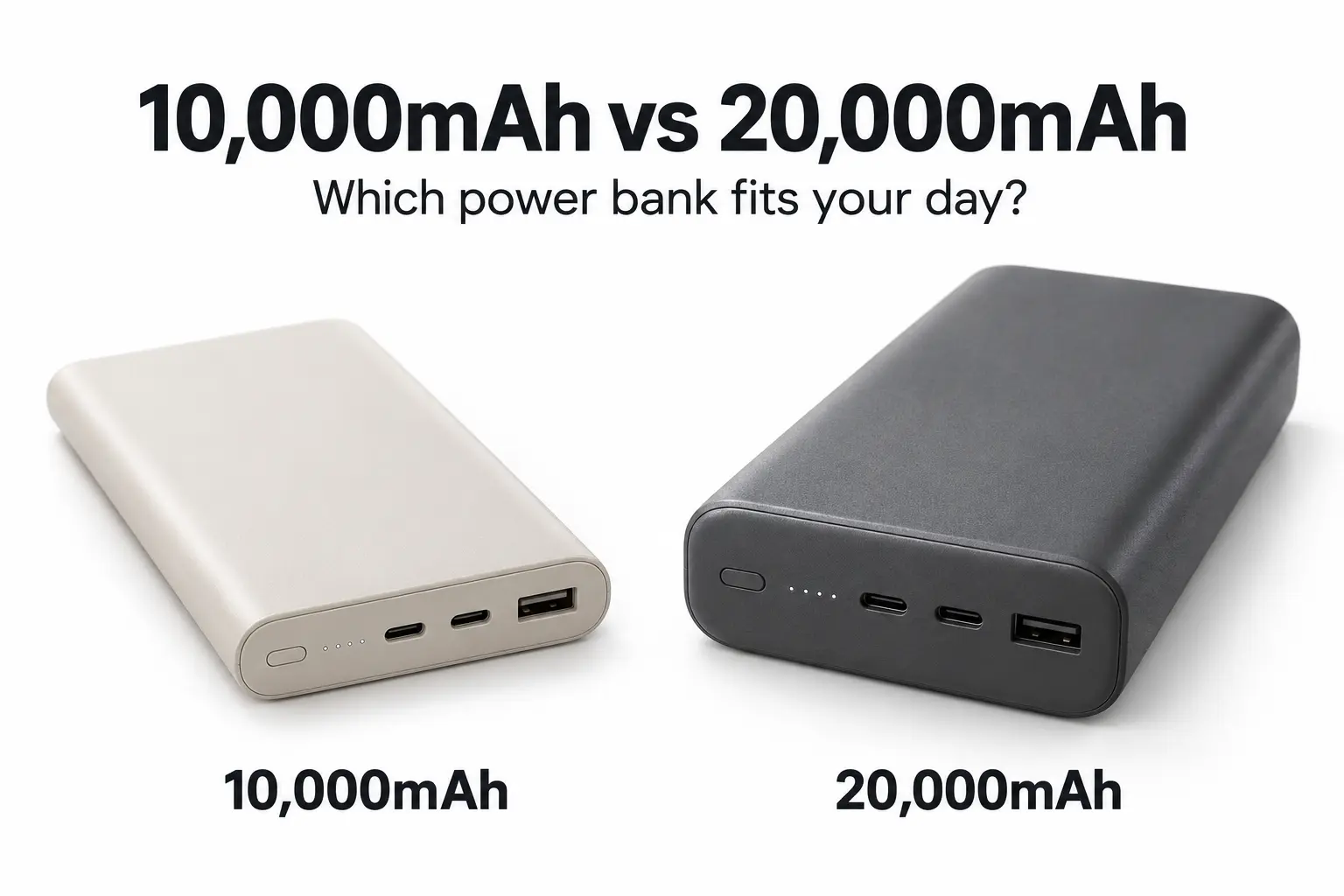
Here is how to decide between a 10000mAh vs 20000mAh power bank for daily use in Pakistan, from university commutes to long load-shedding hours.
Your phone is running low, you still have a few hours before getting home, and there’s no socket nearby. That’s where a power bank earns its place in your bag. But should you choose 10,000mAh or carry the extra capacity of a 20,000mAh model?
For commuting, classes and everyday top-ups, a 10,000mAh power bank is usually easier to carry. A 20,000mAh model makes more sense if you regularly deal with load-shedding, charge more than one device, or spend long stretches away from a socket.
The capacity tells you how much energy the bank can store. How quickly it charges your phone depends on its output, supported charging protocol, and the cable you use.
What does the mAh number actually mean?
The capacity printed on a power bank usually refers to its internal battery at the battery’s own voltage. Some energy is lost as that power is converted and delivered to your phone.
That means a 20,000mAh power bank won’t transfer a full 20,000mAh into your phone’s battery. A 10,000mAh model won’t necessarily give every phone two complete charges, either. The result depends on your phone’s battery size and condition, as well as whether you’re using it while it charges.
When comparing models, check the watt-hour (Wh) rating and the rated output capacity, if listed. Keep these two things separate:
- Capacity, measured in mAh or Wh: how much energy the power bank stores.
- Output power, measured in watts (W): one of the factors that determines charging speed.
Which size fits your routine?
| Your routine | A sensible starting point | What else to check |
|---|---|---|
| Commuting, classes or a few hours out | 10,000mAh | Weight, USB-C output and whether a cable is included |
| A long workday with limited access to electricity | 20,000mAh | Fast-charging support and how long the bank takes to recharge |
| Charging two phones or a phone and tablet | 20,000mAh | How output is shared when both ports are in use |
| Charging a laptop | Choose by output as well as capacity | USB-C Power Delivery support, your laptop’s requirements and the cable rating |
A bigger power bank isn’t always the better choice
If you need a quick top-up before heading out, a 10,000mAh model with suitable fast-charging support could be more useful than a 20,000mAh model with a slow output port.
Read the specifications for the port you’ll actually use. The headline wattage on the packaging may refer to how quickly the power bank itself recharges, or to the combined output of several ports. It doesn’t always tell you how much power one connected phone will receive.
Mobile Geeks has a power-bank collection that includes conventional and magnetic options. Magnetic charging can be convenient, but check compatibility with your exact phone and case. Wired charging is often the more straightforward option when consistent fast charging is your priority.
Three things to check before buying
1. What charging does your device support?
Check your phone’s or laptop’s supported charging protocol and maximum input. A power bank rated at 65W won’t make a phone that accepts 25W charge at 65W. The two devices need compatible charging support to reach the expected speed.
2. What can each port deliver?
Make sure the USB-C port supports output, then check its individual power rating. If you plan to charge two devices together, look for the shared-output figures in the specifications or manual. Connecting a second device may reduce the power available to the first.
3. Will you actually carry it?
Compare weight and dimensions alongside capacity. Also check the warranty and whether the included cable suits your device.
A larger power bank is useful during an outage, but it may feel bulky in a pocket or small bag. For a daily commute, a lighter model you carry consistently can be the more practical choice.
10000mAh vs 20000mAh power bank: our recommendation
For everyday use, start with a 10,000mAh power bank that supports your phone’s charging requirements. It’s usually a good balance between backup power and portability.
Choose 20,000mAh if you need more reserve for frequent outages, long days away from home or multiple devices. Check its output and recharge time before deciding—a larger battery can also take longer to refill.
Browse the Mobile Geeks power-bank collection for current availability, then compare the specifications of the models that fit your routine.
Frequently asked questions
How many times can a 20,000mAh power bank charge my phone?
There isn’t one figure that applies to every phone. Battery size, conversion losses, battery condition and phone use during charging all affect the result. Treat a stated number of charges as an estimate unless the test device and conditions are provided.
Does a 20,000mAh power bank charge faster than a 10,000mAh one?
Not necessarily. A larger capacity gives you more stored energy, but charging speed depends on output power, compatible charging protocols, and the cable.
Can either size charge a laptop?
Some can, provided they offer the USB-C output and charging protocol your laptop requires. You’ll also need a suitable cable. Capacity alone doesn’t confirm laptop compatibility.
Editorial note — remove before publishing: Add two current, in-stock product examples. Include photos of their specification labels and measured weights where available. Only quote a fixed number of phone charges if you can document the phone model and test conditions.
Reference links: Mobile Geeks power-bank collection · USB-IF USB Power Delivery overview